
|
Eager Space | Videos by Alpha | Videos by Date | All Video Text | Support | Community | About |
|---|

Welcome to Eager Space
One of my viewers asked this question recently:
(read)
Nuclear thermal rockets have been a perennial topic for years, starting when the NERVA rocket engine program was cancelled back in 1973. There are always advocates trying to bring them back.
But it turns out that - unless there are significant technological breakthroughs - nuclear thermal rockets are mostly pointless - they aren't worth developing.
To understand why involves a bit of explanation...
We'll start by comparing chemical rockets to nuclear thermal ones.
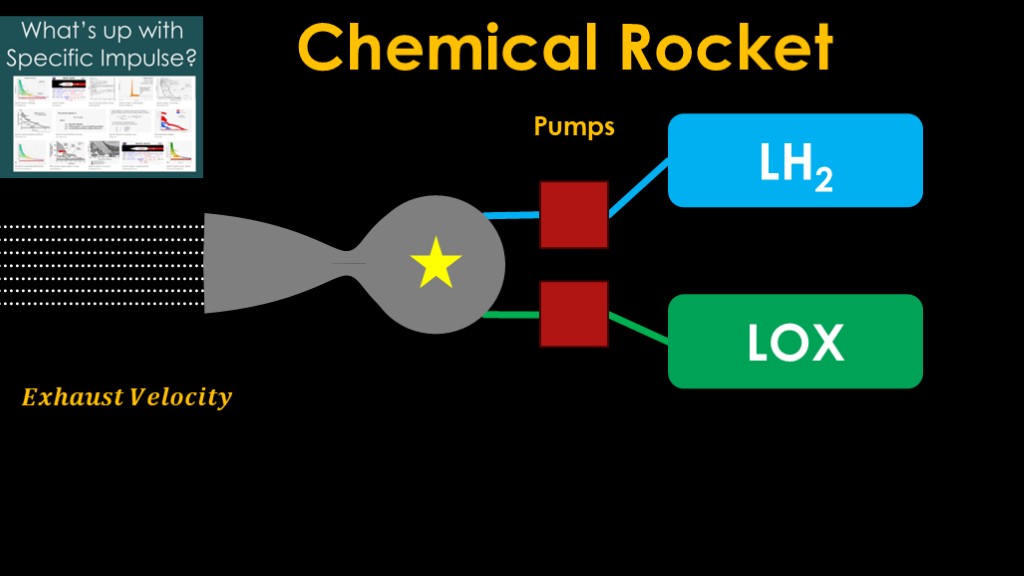
Chemical rockets are very simple conceptually. You have tanks of propellant, with a fuel like liquid hydrogen and an oxidizer like liquid oxygen.
You have a way to get move those propellants into a combustion chamber, and that's where you burn them.
Fire makes things hot, and the products of the combustion exit the nozzle at high speed.
We call that speed the exhaust velocity. If we take the exhaust velocity and divide it by the gravitational constant, we get what is known as the specific impulse of the engine.
I have a whole talk about specific impulse:
https://www.youtube.com/watch?v=7z-UnzRHZiY
The simplest way to think about it is that it's like the fuel economy of a car - it tells you how much useful rocket stuff you can do with a given amount of fuel. And like fuel economy in a car, high specific impulse is generally better.
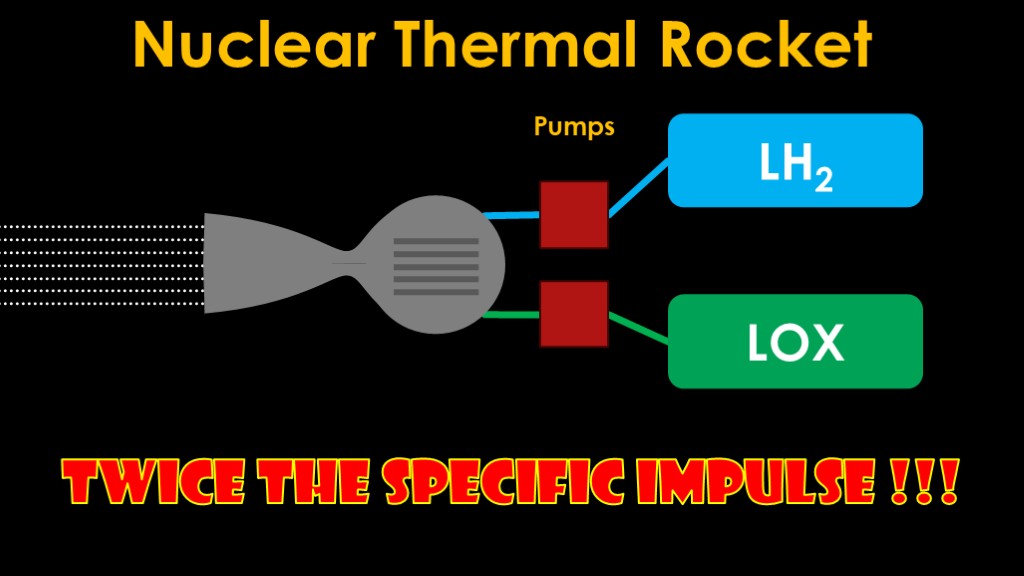
A nuclear thermal rocket doesn't use chemical combustion, and therefore we don't need any liquid oxygen around.
Instead, it fills a heating area with nuclear fuel rods or spheres, creating a small nuclear reactor.
Turn it on and pump liquid hydrogen into it, and the reactor heats up the hydrogen a lot and it exits the nozzle at high speed. A much higher speed than the chemical rocket because hydrogen is very light.
That gives us very high specific impulse - around double what you can get with chemical rockets. That is why they are talked about so breathlessly - double the specific impulse would be transformational, all other things being equal....
The reality is that nuclear thermal advocates focus on the specific impulse and ignore other issues. To explore that, let's build our own nuclear rocket and compare it to a chemical one.
This is going to be a level one analysis - it's going to give us answers that are mostly correct but not precise.
We'll be looking at an upper stage that has been flying for decades, the centaur III. It's currently flying on the last few Atlas V rockets.
It is powered by the RL-10 engine which has been flying forever.
When looking at a rocket stage, we want to know what it can do with a specific payload. We use a measure known as delta V, which is just a measure of work.
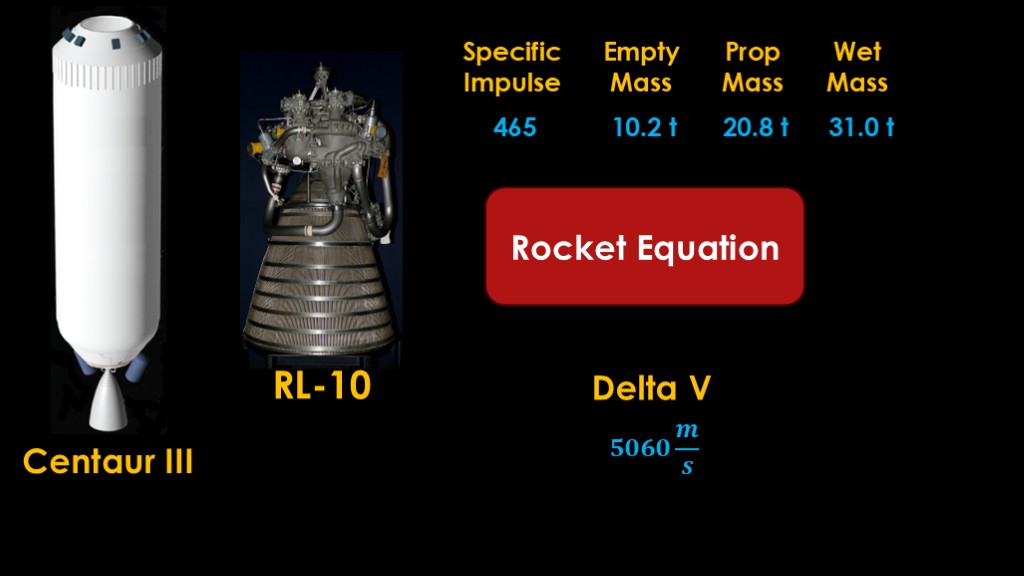
Rockets are actually pretty simple - to figure out the Delta V we need to know a few things: the specific impulse of the engine, the mass of the rocket when it is empty, including the payload, the amount of propellant, and the wet mass when the rocket is full of propellants.
The specific impulse of the highest-performing RL-10 is 465, the empty mass with an 8 ton payload is 10.2 tons, and the wet mass with 20.8 tons of propellant is 31 tons.
Toss that into the rocket equation, and we get a delta v of 5060 meters per second.
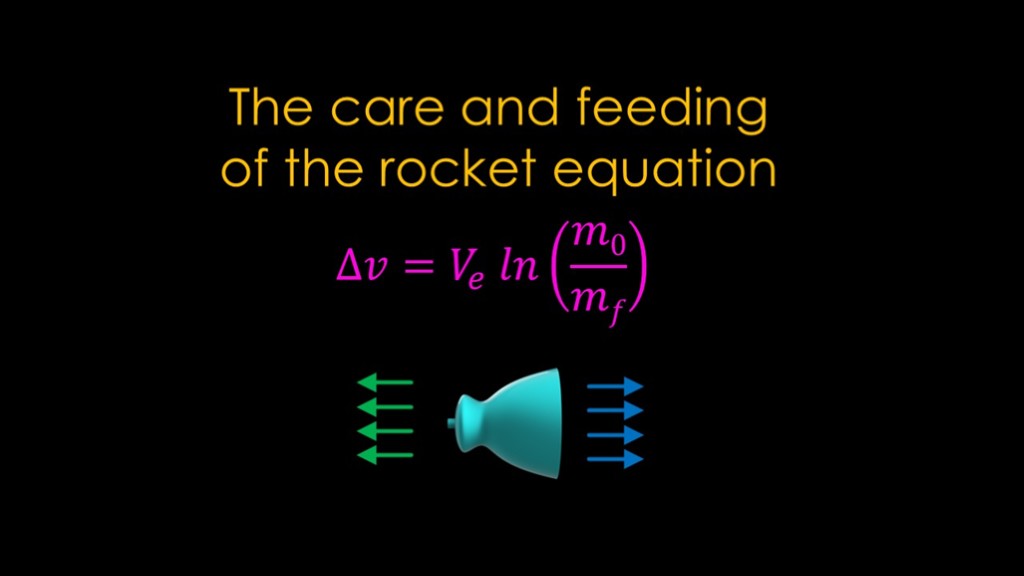
If you want more details on the rocket equation, here's a video for you.
https://www.youtube.com/watch?v=-vVagY3O2Rc
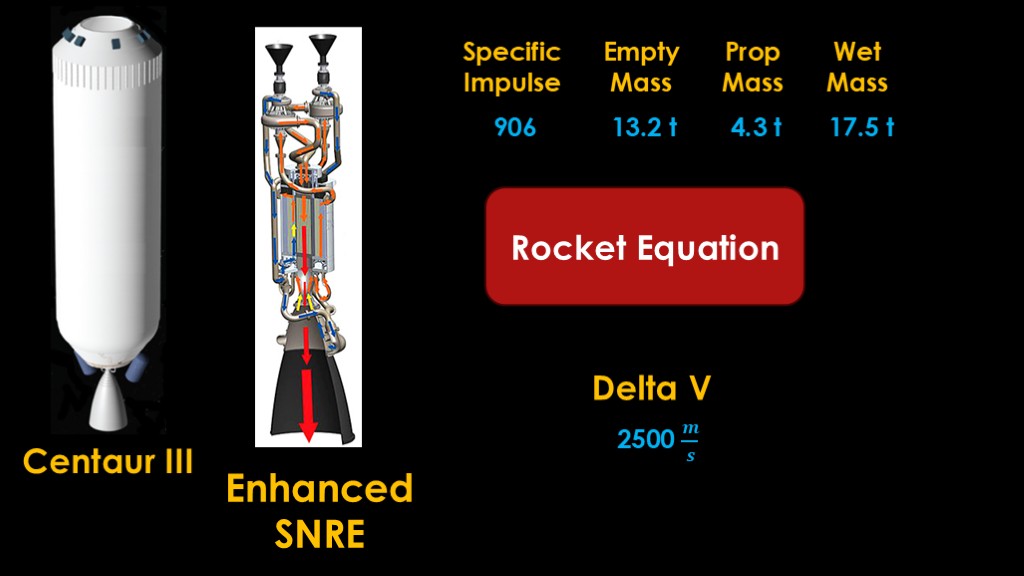
Let's use that same Centaur III stage but replace the chemical engine with a nuclear thermal engine, an engine named the enhanced simple nuclear rocket engine.
I chose that engine because it was designed to give the same amount of thrust as the RL-10 engine.
It has a theoretical specific impulse of 906 - no actual nuclear thermal engines have been built since the NERVA project in the 1970s.
The engine is much heavier than the RL-10, so the empty mass is 3 tons higher, up to 13.2 tons. The propellant mass is 4.3 tons, and the wet mass is 17.5 tons.
Plug that into the rocket equation, and it spits out 2500 meters per second of delta v.
Wait a minute. It has twice the specific impulse but ends up with only half the delta v? Shouldn't it have double the delta v?
This is why you need to look at the values you get with a specific stage rather than just looking at the specific impulse.
The problem is one of density.
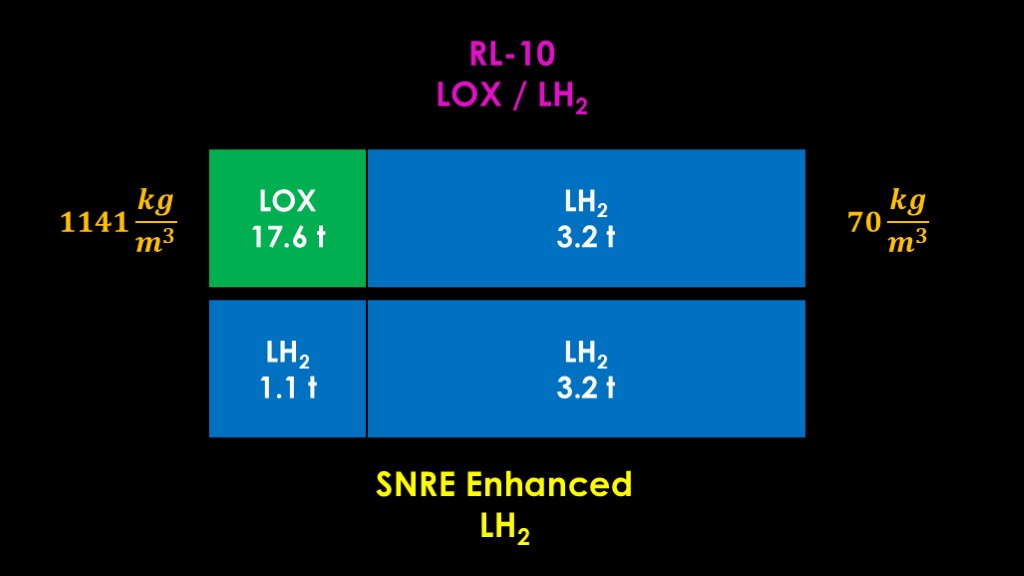
The RL-10 uses roughly ¼ of its propellant volume to store 17.6 tons of liquid oxygen. This is possible because liquid oxygen is very dense, packing 1141 kilograms of mass into each cubic meter of volume.
The density of liquid hydrogen is 70 kilograms per cubic meter - one sixteenth that of liquid oxygen. That means the liquid hydrogen tank is roughly 3 times the volume of the liquid oxygen tank but carries less than 20% of the mass of the liquid oxygen.
When we switch over to the nuclear engine, we fill the oxygen tank with liquid hydrogen, but can only stuff in a little over a ton.
That's why the delta v is so low - there's not much propellant.
This isn't really a fair comparison. We need bigger tanks.
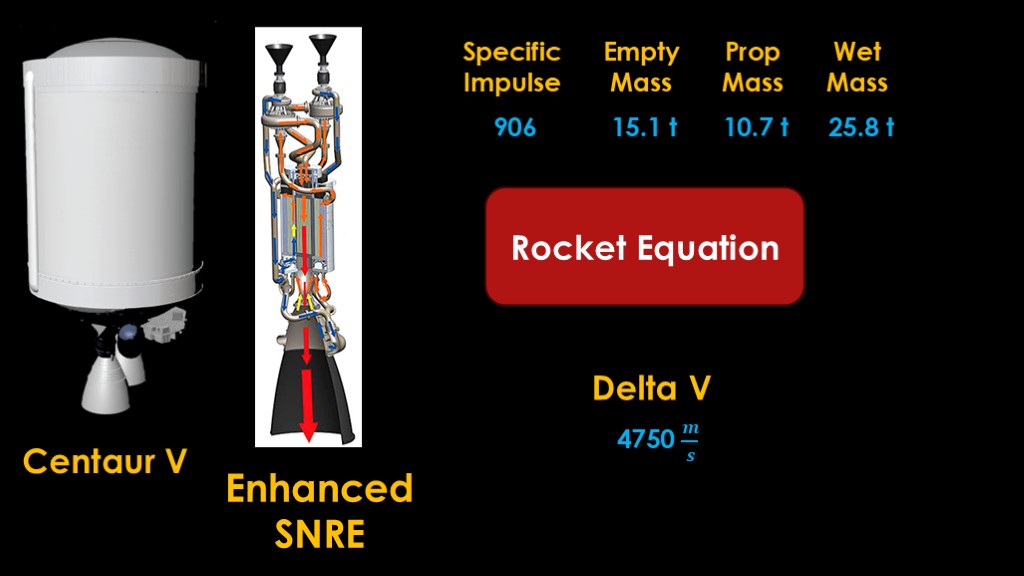
We're going to substitute the much larger Centaur V that flies on ULA's Vulcan rocket. It carries 2.5 times the amount of propellant as centaur III.
I'm going to assume the mass of this larger stage without the engine is double that of the Centaur III, and that gives us an empty mass of 15.1 tons. We now get 10.7 tons of propellant and a wet mass of 25.8 tons.
Run that through the rocket equation, and we get a delta v of 4750 meters per second.
We're getting closer, but it's still less than the chemical rocket.
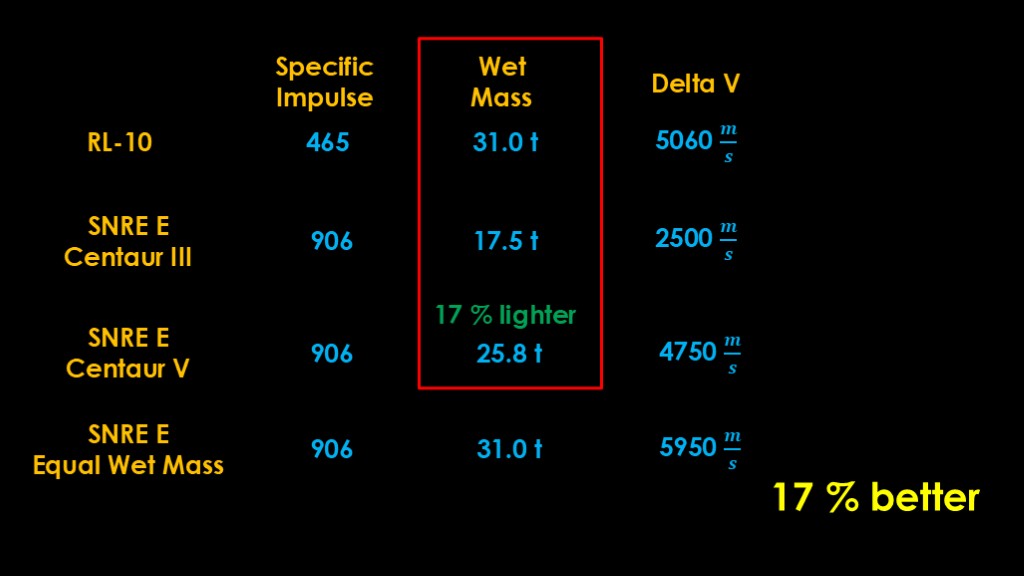
In summary, the Centaur III tanks with an RL-10 give 5060 meters per second. If we go up to the Centaur V size tank, the SNRE enhanced gets 4750 meters per second. Less than the RL-10 stage, but note that it's about 17% lighter.
Bump up the size of the tanks so they have equivalent wet mass, and we end up with these numbers. The nuclear model gets 5950 meters per second of delta v, beating the RL-10 model by 17%.
That's a relatively small difference, but it's hard to get delta v gains when the numbers are high, so this might be useful.
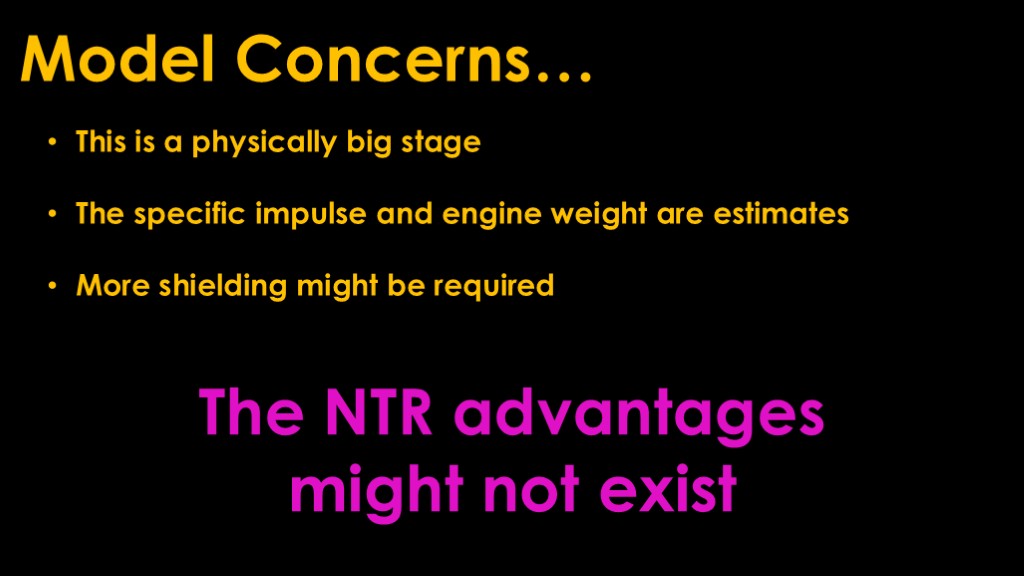
I do have a few concerns of this model.
This is a physically big stage. It may not fit on some launch platforms or it may require modifications.
With the exception of the NERVA nuclear thermal engines from the 1970s, none of these engines have been built. That means the specific impulse and engine weight are estimates. Specific impulse depends on the temperature in the reactor and high temps may be hard to achieve in reality. We all know that pretty much everything in the spaceflight world ends up weighing more than it is projected to weigh. Miss the specific impulse or weight targets, and that will eat into the advantage of the nuclear thermal engine.
Nuclear thermal engines require shielding because they are radioactive during and after operation. The stage might require more shielding than what is accounted for in the engine design, and that also will eat into the advantage of the nuclear thermal engine.
In other words, the NTR advantages in the model might not exist.
What does the overall picture look like?
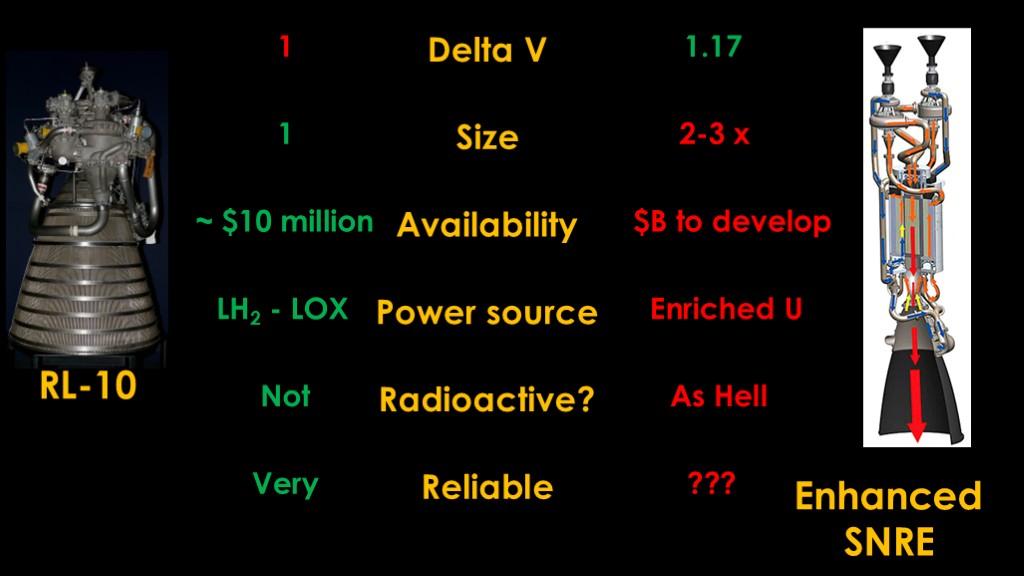
The NTR wins the delta v battle - it produces about 17% more delta v for a given launch mass. Or it can produce the same delta v with a smaller launch mass.
It is, however, a much bigger stage.
You can buy an RL-10 off-the-shelf from Aerojet rocketdyne for something like $10 million, while your nuclear rocket engine will take billions to develop and it will never be a cheap engine.
The RL-10 uses liquid hydrogen and liquid oxygen, and the nuclear rocket uses enriched uranium. Some designs use weapons-grade uranium, which is mostly considered a non-starter. Some designs use less enriched uranium which can only be used to make poorly-performing bombs. There are a ton of hoops to jump through to work with nuclear materials in the US and that increases the development cost significantly. Not to mention the approval process for launch and the pushback you will get.
The RL-10 is not radioactive, and after startup the nuclear rocket is radioactive as hell.
The RL-10 has flown for many many years and is hugely reliable, and the reliability of the nuclear rocket is unknown.
It's not looking great for the nuclear thermal rocket.
There's also the problem of testing.
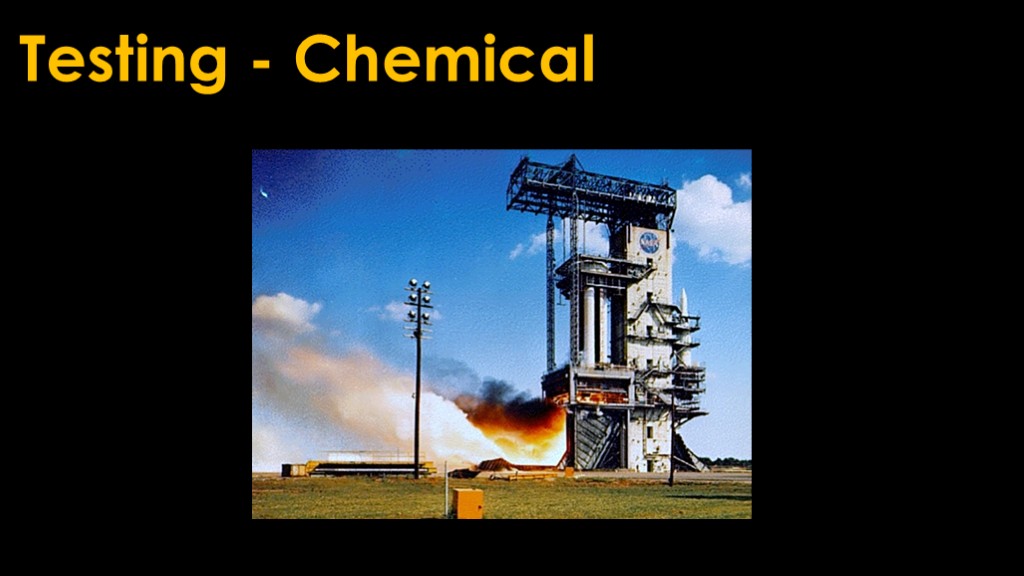
Chemical rockets are fairly easy to test. You need a place that is remote enough to do the testing, and that's about it. NASA has test sites you can use, and SpaceX, Blue Origin, and others own and operate their own test sites.
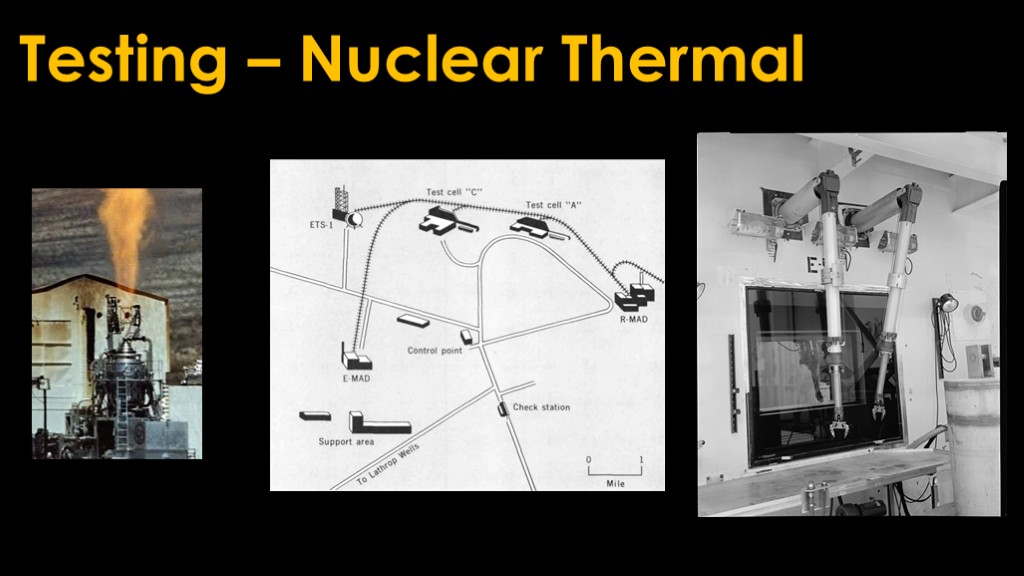
Back when NERVA was being developed, they just tested engines out in the open air. The exhaust is mostly non-radioactive hydrogen, until something goes wrong with the engine test and then it spews radioactive material all over the test site.
They operated out of a site known as Jackass flats in Nevada.
After test firings, the engines were returned to the main facility to be disassembled using remote manipulators to protect the operators from the radiation of the engine, the same sort of precautions used in nuclear reactor reprocessing.
That sort of approach is not environmentally viable in today's world.
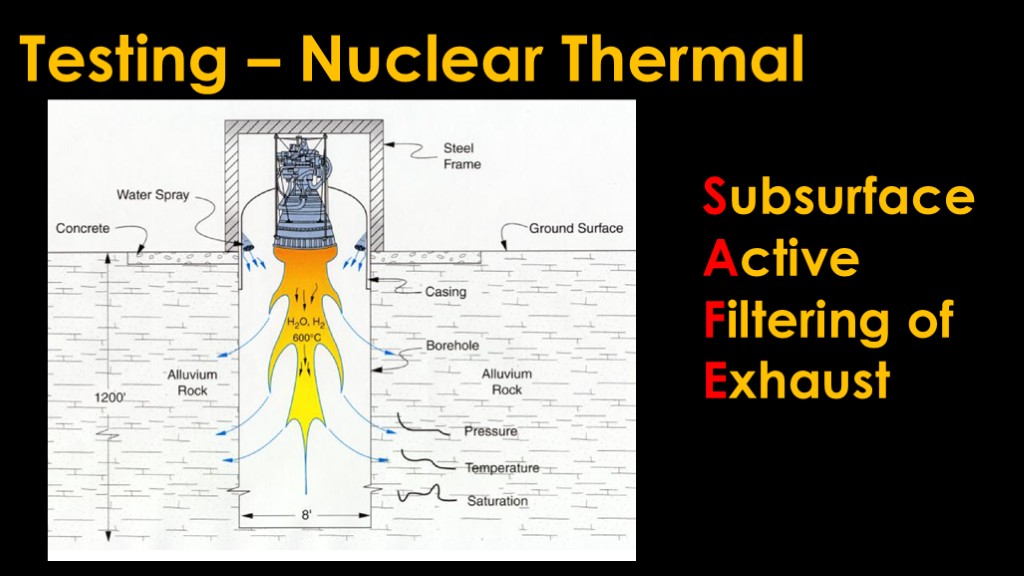
There have been a number of proposed ways of testing nuclear thermal engines.
This is one known as subsurface active filtering of exhaust.
You drill an 8' hole 1200' deep into the earth and erect a sealed building over the hole. You then test the engine while spraying water into the hot exhaust. The results of the combustion would be cooled and trapped in the hole and would later be scrubbed to remove any harmful exhaust products.
You are then left with a highly radioactive engine inside a radioactive building. I'm not sure what you do then.

This discussion would be easier to have if there were a real world NTR stage with known numbers that could be compared to chemical stages
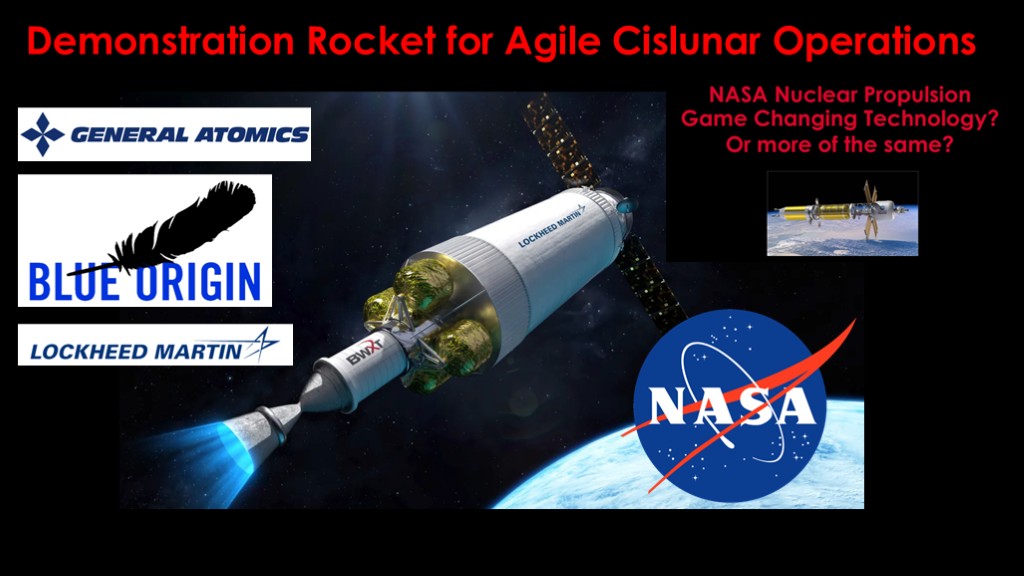
That brings us to the demonstration rocket for agile cislunar operations, or DRACO. It was started by DARPA - the defense advanced research projects agency - in 2021 with awards to General Atomics, Blue Origin, and Lockheed Martin for conceptual designs.
Then, in 2023, NASA joined the DRACO project.
NASA already had their own demonstration project known as "space nuclear power and propulsion" which I honestly think was more ambitious than DRACO, but I haven't heard anything about it since NASA joined DRACO.
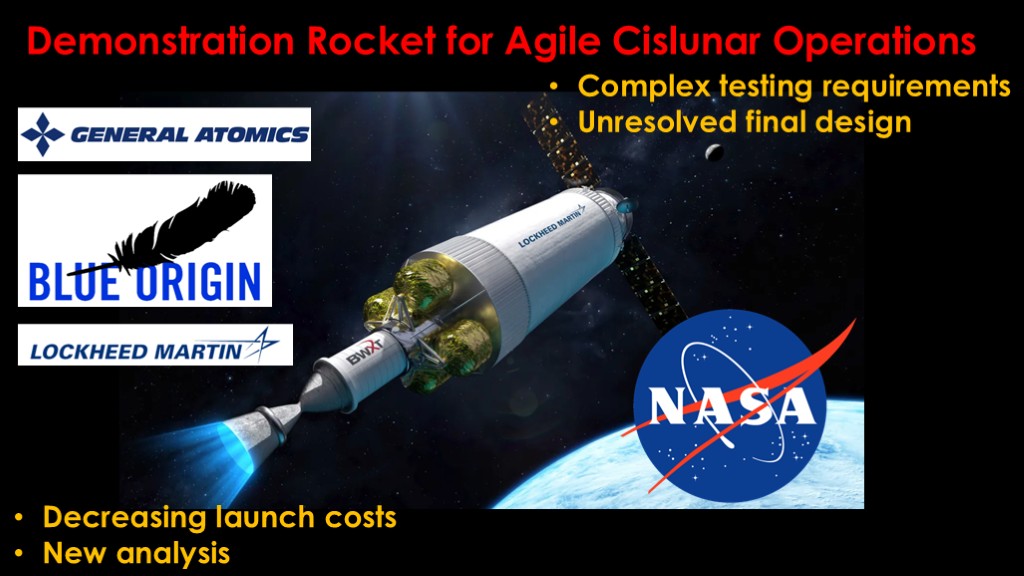
Unfortunately, in January of 2025 the planned 2027 launch was placed on indefinite hold due to the complexity of testing the nuclear engine on the ground and an unresolved design for the propulsion system.
The project was not included in the 2026 NASA budget request, and in June of 2025, DARPA announced a termination of the program, based on an assessment that the costs no longer matched the benefits, due to decreasing launch costs and new analysis of the performance benefits. Remember that the real benefit of the nuclear stage was that it was a little lighter - and therefore cheaper to launch - than the chemical stage, but with launch costs going down that isn't much of a benefit in the real world.
The information from the DRACO program was supposedly transferred to NASA, but I wasn't able to find any details of nuclear projects in the 2026 NASA fundings data nor any updated status of the pre-DRACO NASA project.
I did hear from one person who says that NASA is still working on it.
Nuclear thermal rockets sound great
but even in the best cases, the benefits do not outweigh the disadvantages
They are therefore mostly pointless
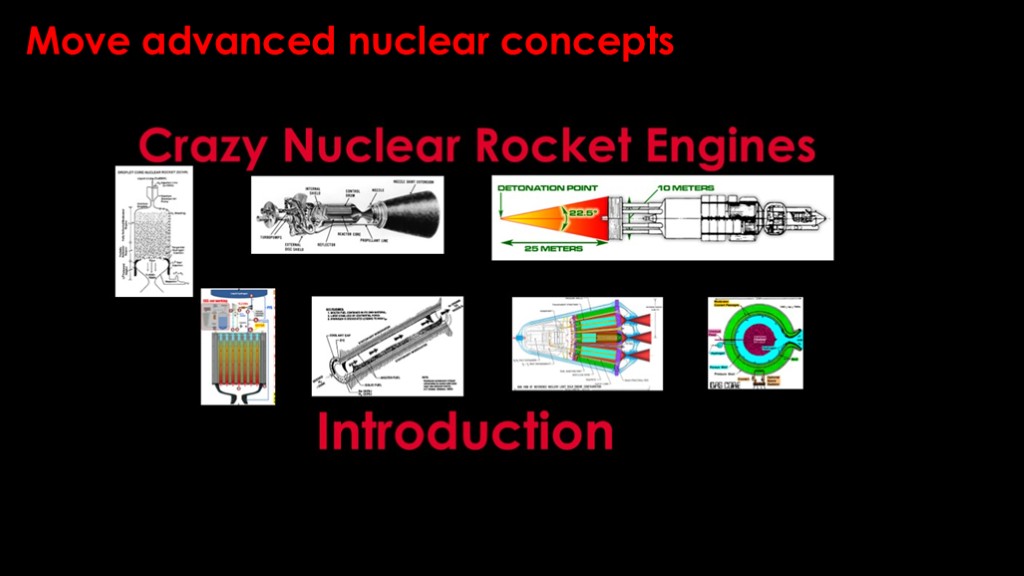
For a look at some wilder concepts, I have a series of videos named "Crazy nuclear rocket engines".
https://www.youtube.com/watch?v=7GL9aKLYz4U&list=PLNDavGvRFdB496mL28_2r6r_hSVqSphn0

That's all for this video.
Today's song is Block Rockin Beats by the Chemical Brothers, from their 1997 album Dig Your Own Hole.
https://www.youtube.com/watch?v=iTxOKsyZ0Lw